Florida Boat Registration: Fees by Length, Title Rules, Numbers and Decal Placement
Bought a boat, moved here with one or wondering if your kayak counts? See whether your boat needs Florida registration and a title, what it costs by length, and how to show the numbers and decal.
By DMV Florida Guide Team · Reviewed by Content Accuracy Team · checked against Florida Statutes, FLHSMV and county Tax Collectors
Every boat with a motor used on Florida public waters needs Florida boat registration and, in most cases, a title, within 30 days of purchase at a county Tax Collector. The yearly fee goes by length, from $5.50 under 12 feet to $189.75 at 110 feet or more. Canoes and kayaks without a motor are exempt.
Does your boat need Florida registration, and what will it cost?
Tell us about the boat and we’ll show whether it needs a Florida title and registration, the fee for its length in your county, your 30-day deadline and what to bring.
Which boats need Florida registration and a title?
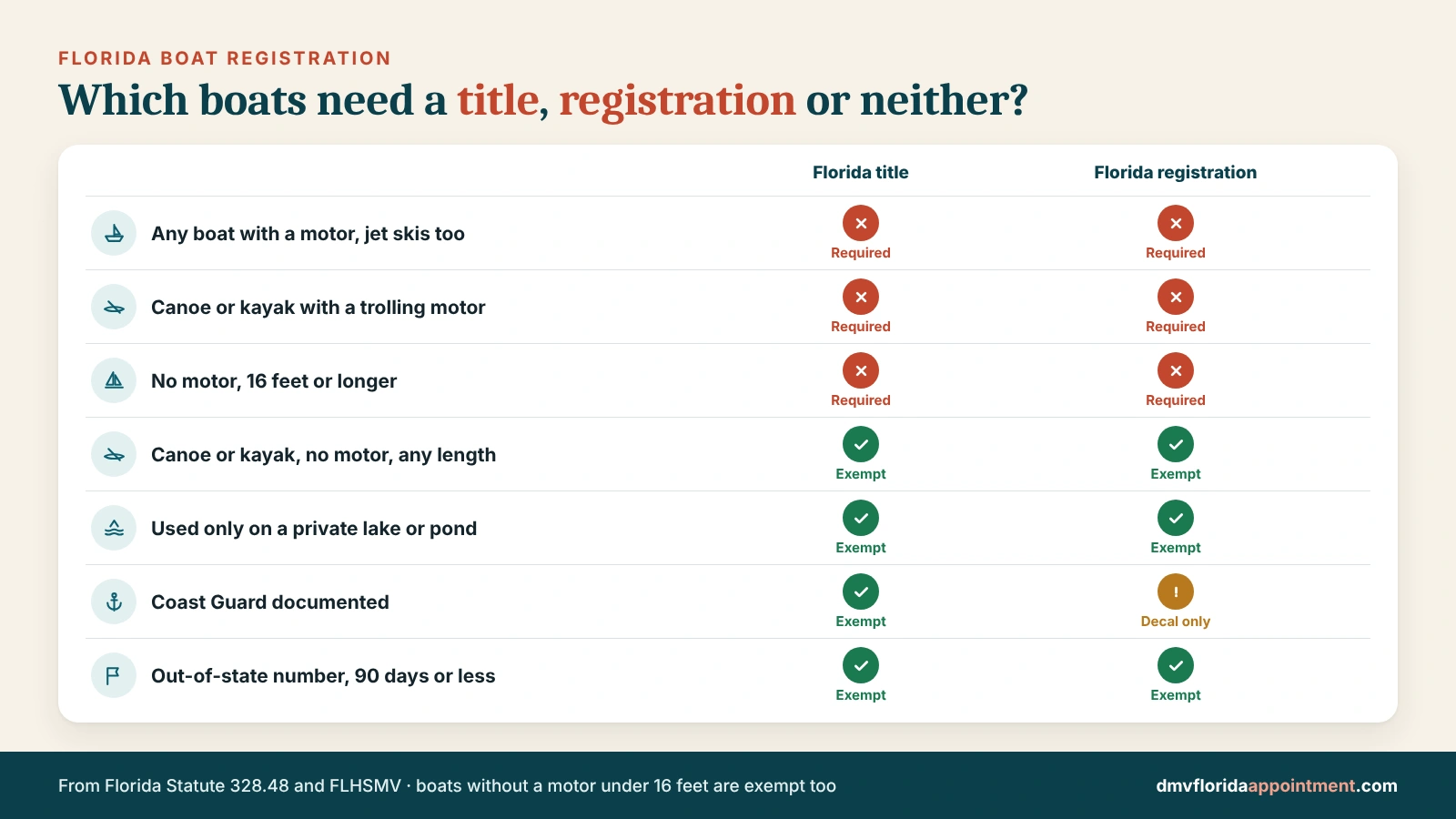
Any boat that is used, kept or stored on Florida public waters must be registered unless it fits an exemption in Florida Statute 328.48. Boats with a motor need a Florida title too. A paddle-only kayak or canoe needs neither.
| Boat | Registration | Title |
|---|---|---|
| Any boat with a motor, including jet skis | Required | Required, unless federally documented |
| Canoe or kayak with a trolling motor | Required (a canoe with a motor is Class A-1 at any length) | Required |
| Sailboat or other boat with no motor, 16 feet or longer | Required | Required |
| Boat with no motor under 16 feet | Exempt | Exempt |
| Canoe, kayak, racing shell or rowing scull with no motor, any length | Exempt | Exempt |
| Used only on a private lake or pond | Exempt | Exempt |
| Federally documented with the Coast Guard | Required (decal only) | Exempt |
| Numbered in another state, in Florida 90 days or less | Exempt | Exempt |
From Florida Statute 328.48, 328.56 and FLHSMV’s vessel titling and registration page. Operating an unregistered boat more than 30 days after purchase is a second-degree misdemeanor, FLHSMV says.
How much is Florida boat registration?
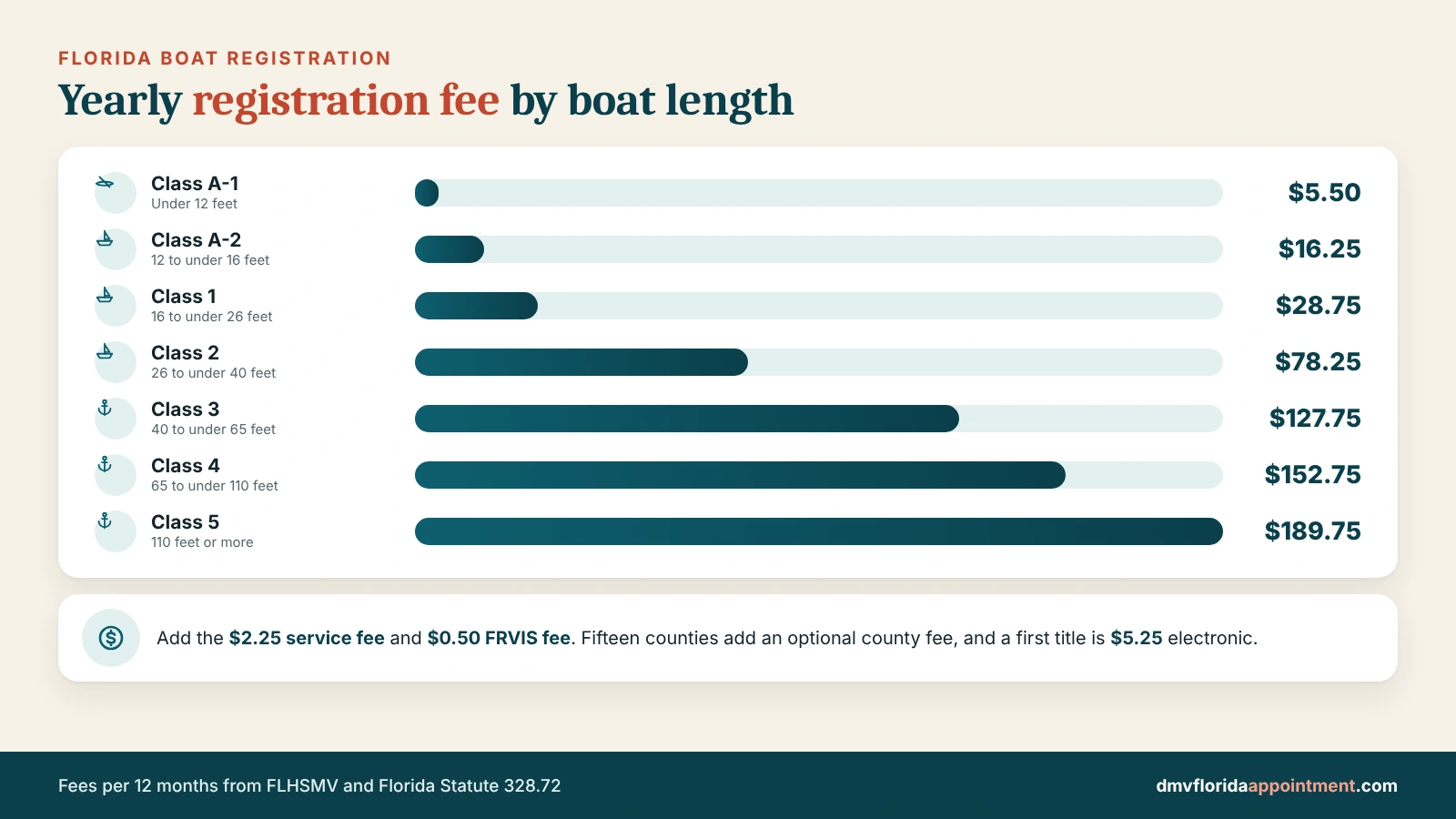
The yearly fee depends on the boat’s length, from $5.50 under 12 feet to $189.75 at 110 feet or more. FLHSMV adds a $2.25 service fee and a $0.50 FRVIS fee, and 15 counties add an optional county fee. A first title is $5.25 electronic or $7.75 on paper.
| Class | Boat length | Yearly fee | EPIRB or PLB rate | Optional county fee |
|---|---|---|---|---|
| A-1 | Under 12 feet, and canoes with motors | $5.50 | $2.95 | $1.75 |
| A-2 | 12 to under 16 feet | $16.25 | $11.00 | $7.13 |
| 1 | 16 to under 26 feet | $28.75 | $20.40 | $13.37 |
| 2 | 26 to under 40 feet | $78.25 | $57.50 | $38.13 |
| 3 | 40 to under 65 feet | $127.75 | $94.95 | $62.88 |
| 4 | 65 to under 110 feet | $152.75 | $113.40 | $75.38 |
| 5 | 110 feet or more | $189.75 | $141.15 | $93.88 |
Fees per 12 months from FLHSMV’s vessel titling page and Florida Statute 328.72. The optional county fee applies in Broward, Charlotte, Collier, Miami-Dade, Hardee, Hillsborough, Lee, Manatee, Martin, Monroe, Palm Beach, Pinellas, Polk, Sarasota and Volusia. You can register for one or two years.
Title fees
- Electronic title: $5.25
- Paper title: $7.75
- Fast (expedited) title: $11
- Each lien recorded: $1
- Boat registered out of state before: $4 more
Other boat fees
- Transfer of ownership: $3.25, within 30 days
- Duplicate registration certificate: $2.25
- Replacement decal: $2.25
- Nonresident or alien commercial boat: $50 a year
From Florida Statute 328.72.
Measuring length
Use the length on your title or certificate of origin. A boat right at a class line, such as exactly 16 feet, falls in the higher class, because each class runs up to just under the next mark.
Is there still a cheaper rate for boats with a beacon?
Two official sources describe the EPIRB and PLB discount differently.
- Florida Statute 328.72(18)Sets reduced yearly fees, such as $20.40 instead of $28.75 for 16 to under 26 feet, for a recreational boat with an emergency position-indicating radio beacon (EPIRB), or whose owner has a personal locator beacon (PLB). A PLB counts for one boat only.
- FLHSMV’s vessel titling and registration pageLists the same reduced fees but says they were effective July 1, 2016 through June 30, 2017, only for registrations made in an office.
Bring proof of the beacon and ask your Tax Collector, or call FLHSMV at 850-617-2000.
How do you register a boat in Florida?
Apply at a county Tax Collector or license plate agent within 30 days of buying the boat. Bring proof of ownership and form HSMV 82040, pay the fee for its length plus any title fee and sales tax, then put the number and decal on the boat.
- Check that your boat needs itAny boat with a motor that is used, kept or stored on Florida public waters needs registration. Paddle craft such as canoes and kayaks without a motor, and boats without a motor under 16 feet, are exempt.
- Gather proof of ownershipBring the signed title, or for a new boat the manufacturer’s certificate of origin. From a state that doesn’t title boats, bring that state’s registration and a bill of sale with the full boat description.
- Apply at your Tax Collector within 30 daysFile form HSMV 82040 at a county Tax Collector or license plate agent, pay the fee for your boat’s length, the title fee and any sales tax, and keep proof of the purchase date on board until then.
- Put the numbers and decal on the boatApply the number in block letters at least 3 inches high on both sides of the front half of the boat, then place the decal on the left (port) side within 6 inches of the number.
What to bring
- New from a dealer: manufacturer’s certificate of origin and the dealer’s bill of sale
- Used, Florida title: the title signed over to you
- Used, titled in another state: that title, signed over
- From a state without boat titles: its current registration and a bill of sale from the registered owner
- Homemade under 16 feet: forms HSMV 82040 and HSMV 87002
What the bill of sale must show
FLHSMV wants a full description: maker, year, type, hull material, propulsion, fuel, use, hull identification number and length. Selling a motor separately? Our Florida bill of sale guide shows how listing each price can lower the sales tax.
Where do the registration numbers and decal go on a boat?
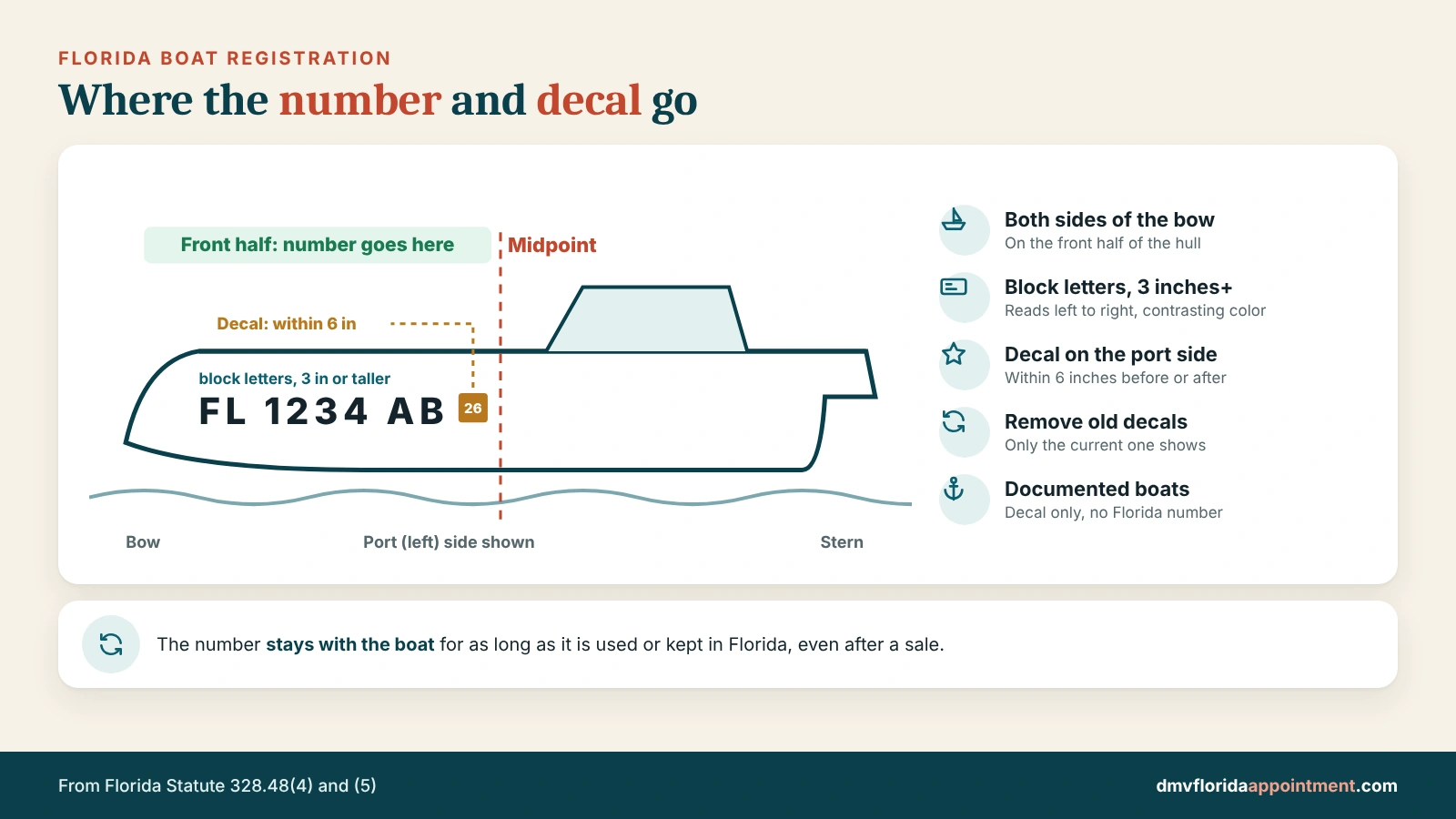
Put the number on both sides of the front half of the boat, reading left to right, in block characters at least 3 inches high. The decal goes on the left (port) side, within 6 inches before or after the number. Remove last year’s decal.
The number
- Both sides, front half of the boat
- Block characters, 3 inches or taller
- Reads left to right
- An airboat may show it on each side of the rudder
The decal
- Left (port) side only
- Within 6 inches before or after the number
- Old decals come off
- A decal lost in the mail is replaced free
Documented boats
A Coast Guard documented boat shows no Florida number. Its decal goes on the port side, and it can go on a port-side window or windshield instead of the hull.
From Florida Statute 328.48(4) and (5). The number stays with the boat for as long as it is used or kept in Florida, even after a sale, the Palm Beach County Tax Collector notes.
How does Florida boat registration renewal work?
A boat registered to a person renews on a birthday cycle, and the renewal window is the 30 days ending on the owner’s birthday. Boats registered to a business, dealer or government renew from June 1 and expire June 30. Many Tax Collectors renew online, by mail or in person.
Ways to renew
Online, by mail or at an office, depending on your county. The Okaloosa County Tax Collector, for example, lists all three. Bring the renewal notice or your registration number.
Let it lapse?
An expired boat registration is a noncriminal infraction under Florida Statute 328.72, whether it ran out recently or more than six months ago. A boat lawfully stored at a dock or marina is exempt from that penalty.
Moved or sold?
Update your registration details with the Tax Collector within six months of a change. A new owner has 30 days to transfer the registration, and the transfer fee is $3.25.
Trailers, sales tax and other boat rules
The trailer is registered on its own, sales tax on a boat is capped, and operators born on or after January 1, 1988 need an FWC card for engines of 10 horsepower or more. These are the rules boat buyers ask about most after registration.
Boat trailers
Florida titles and registers the boat and the trailer separately, and the trailer fee depends on its weight. The Palm Beach County Tax Collector says trailers of 2,000 pounds or more need a title too, and a homemade trailer needs a certified weight slip.
Sales tax and the $18,000 cap
If tax wasn’t paid when you bought the boat, it is due at registration. The Florida Department of Revenue caps the total tax on one boat at $18,000, county surtax included. In a private sale, an outboard motor priced separately on the bill of sale can be left out of the tax, FLHSMV says.
Boating safety card
If you were born on or after January 1, 1988, you need an FWC Boating Safety Education ID card to operate a boat with a motor of 10 horsepower or more. It is separate from the boat’s registration.
Found an abandoned boat?
Florida has no finders-keepers rule for boats. Report it to law enforcement under Florida Statute 705.103; if no owner claims it, the agency can transfer it to you, and you then apply to FLHSMV for the title.
Florida boat registration questions
Do I need to register my boat in Florida?
Yes, if you use, keep or store it on Florida public waters and it has a motor, or it is 16 feet or longer without one. Florida Statute 328.48 exempts boats used only on private lakes or ponds, boats without a motor under 16 feet, and canoes, kayaks, racing shells and rowing sculls without a motor at any length.
How much does it cost to register a boat in Florida?
The yearly fee depends on length: $5.50 under 12 feet, $16.25 from 12 to under 16 feet, $28.75 from 16 to under 26 feet and $78.25 from 26 to under 40 feet. FLHSMV adds a $2.25 service fee and a $0.50 FRVIS fee, 15 counties add an optional county fee, and a first title costs $5.25 for an electronic title.
Do kayaks and canoes need to be registered in Florida?
Not if they have no motor. Florida exempts canoes, kayaks, racing shells and rowing sculls without a motor, whatever their length. Add a trolling motor or any other motor and the kayak or canoe must be titled and registered like any other motorboat.
Does a federally documented boat need Florida registration?
Yes, but not a Florida title. A boat documented with the U.S. Coast Guard is exempt from Florida titling and from showing a Florida number, but it still needs a Florida registration, and its decal goes on the left (port) side or a port-side window.
Can I renew my Florida boat registration online?
Usually, yes. Many county Tax Collectors renew vessel registrations online, by mail or in person; Okaloosa County, for example, lists all three. Registrations in a person’s name run on a birthday cycle, and business registrations expire June 30.
How long can an out-of-state boat stay in Florida without Florida registration?
Up to 90 consecutive days, if it has a valid number from another state or from the U.S. Coast Guard. After that, register it with a Florida Tax Collector.
Does a boat trailer need its own registration in Florida?
Yes. A boat and its trailer are titled and registered separately, and the trailer fee depends on its weight. The Palm Beach County Tax Collector says a boat trailer of 2,000 pounds or more also needs a title.