Florida Disabled Veteran License Plate: Who Qualifies, DV vs Wheelchair Plate and Parking Rights
Rated 100 percent disabled from your service? See if you qualify for a free Florida disabled veteran license plate, what to bring, how it differs from the wheelchair and specialty versions, and the parking rights it gives.
By DMV Florida Guide Team · Reviewed by Content Accuracy Team · checked against Florida Statutes, FLHSMV procedures and bulletins
A Florida disabled veteran license plate (the “DV” plate) is free of the annual license tax for an honorably discharged veteran with a 100 percent service-connected rating who has lived in Florida five years or filed a domicile declaration. It works like a disabled parking permit and parks free at public airports.
Do you qualify for a Florida disabled veteran license plate?
Answer a few questions to see whether you qualify, which version of the plate fits you, and what to bring to the Tax Collector.
Who qualifies for a Florida disabled veteran license plate?
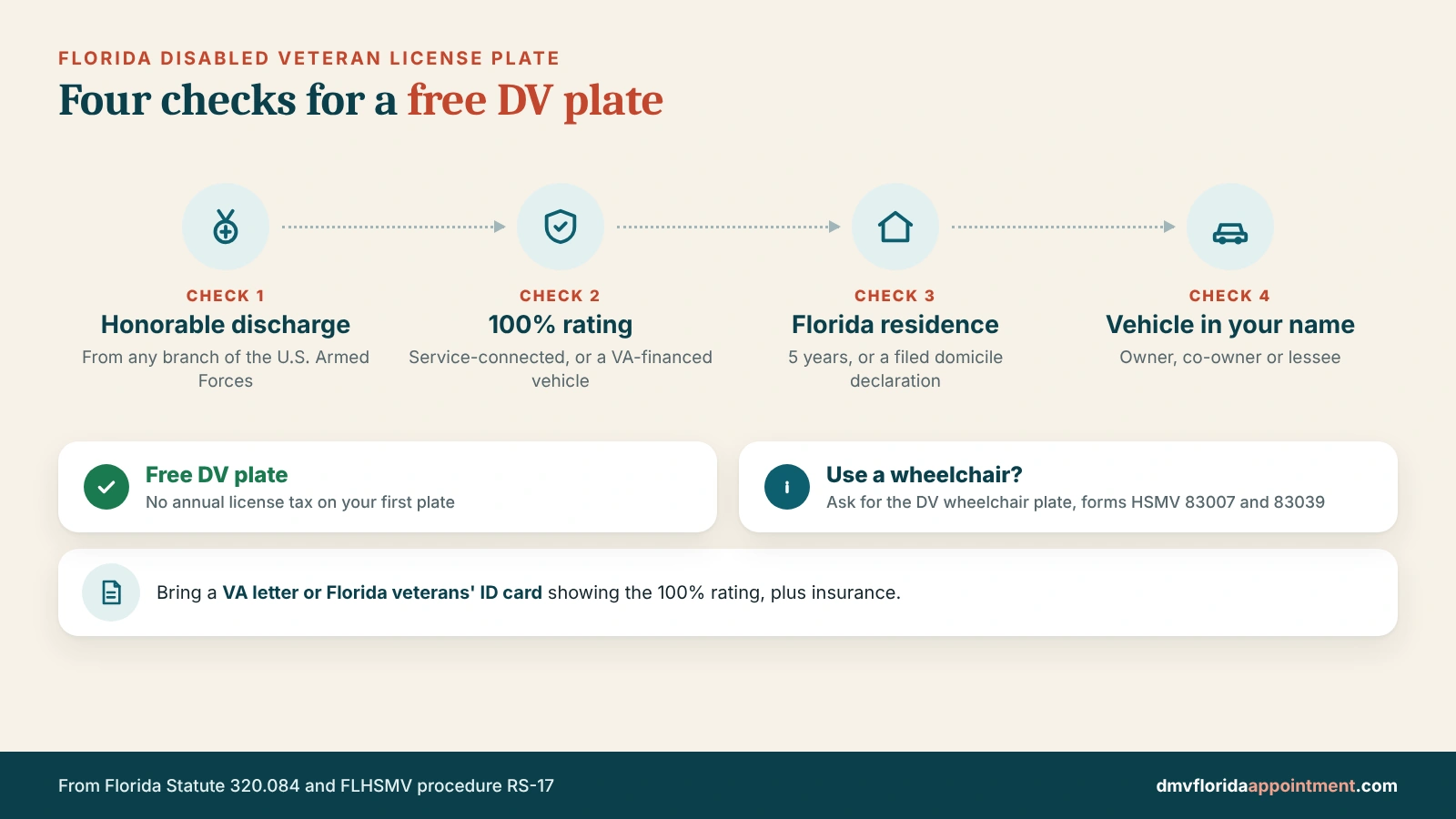
Under Florida Statute 320.084, you need an honorable discharge from the U.S. Armed Forces, Florida residence for the past five years or a declared Florida domicile, and one of three things: a vehicle first bought with VA help for an automobile, a 100 percent VA rating, or a 100 percent rating plus disability retirement pay.
Honorable discharge
From any branch of the U.S. Armed Forces.
One of three
- A vehicle first bought with VA financial help for an automobile
- A 100 percent service-connected rating for compensation
- A 100 percent rating and disability retirement pay from a branch
Five years, or a declaration
New to Florida? The five-year wait doesn’t apply if you declare Florida domicile: file a sworn statement with the clerk of the circuit court in your county, as Florida Statute 222.17 describes.
What do you need to apply for a DV plate?
Bring proof of the 100 percent rating, proof of Florida residence, proof that the vehicle is in your name and proof of Florida insurance to any county Tax Collector or license plate agency. The regular DV plate needs no special application form.
- Check that you qualifyYou need an honorable discharge, a 100 percent service-connected rating (or a VA-financed vehicle), and Florida residence for five years or a filed Florida domicile declaration.
- Gather your proofBring a Florida Department of Veterans’ Affairs ID card or a VA letter showing the 100 percent rating, proof of Florida residence, the vehicle’s title or registration in your name, and proof of Florida insurance.
- Apply at a Tax Collector officeAny county Tax Collector or license plate agency issues the plate. For the wheelchair version, add forms HSMV 83007 and HSMV 83039.
- Renew and keep it currentAt each yearly or two-year renewal you confirm, in writing or out loud, that you are still eligible. Return the plate if the rating drops below 100 percent.
| You need | What counts |
|---|---|
| Proof of the rating | A Florida Department of Veterans’ Affairs ID card, or a VA “Summary of Benefits” letter showing the 100 percent rating |
| Proof of Florida residence | A sworn affidavit of five years’ residence, a copy of a filed Declaration of Domicile, a Florida voter registration card, or a Florida driver license or ID card |
| Proof the vehicle is yours | A current Florida registration or Florida title in your name; a vehicle new to Florida is titled at the same visit. Leased? Bring the lease |
| Insurance | Proof of Florida insurance on the vehicle |
| Wheelchair version only | Forms HSMV 83007 and HSMV 83039, and a copy of the registration |
From FLHSMV procedure RS-17 (revised March 2022) and Florida Statute 320.084(2), which treats a VA letter or Florida veterans’ ID card as proof of the rating.
DV plate, DV wheelchair plate or a specialty plate with “DV”?
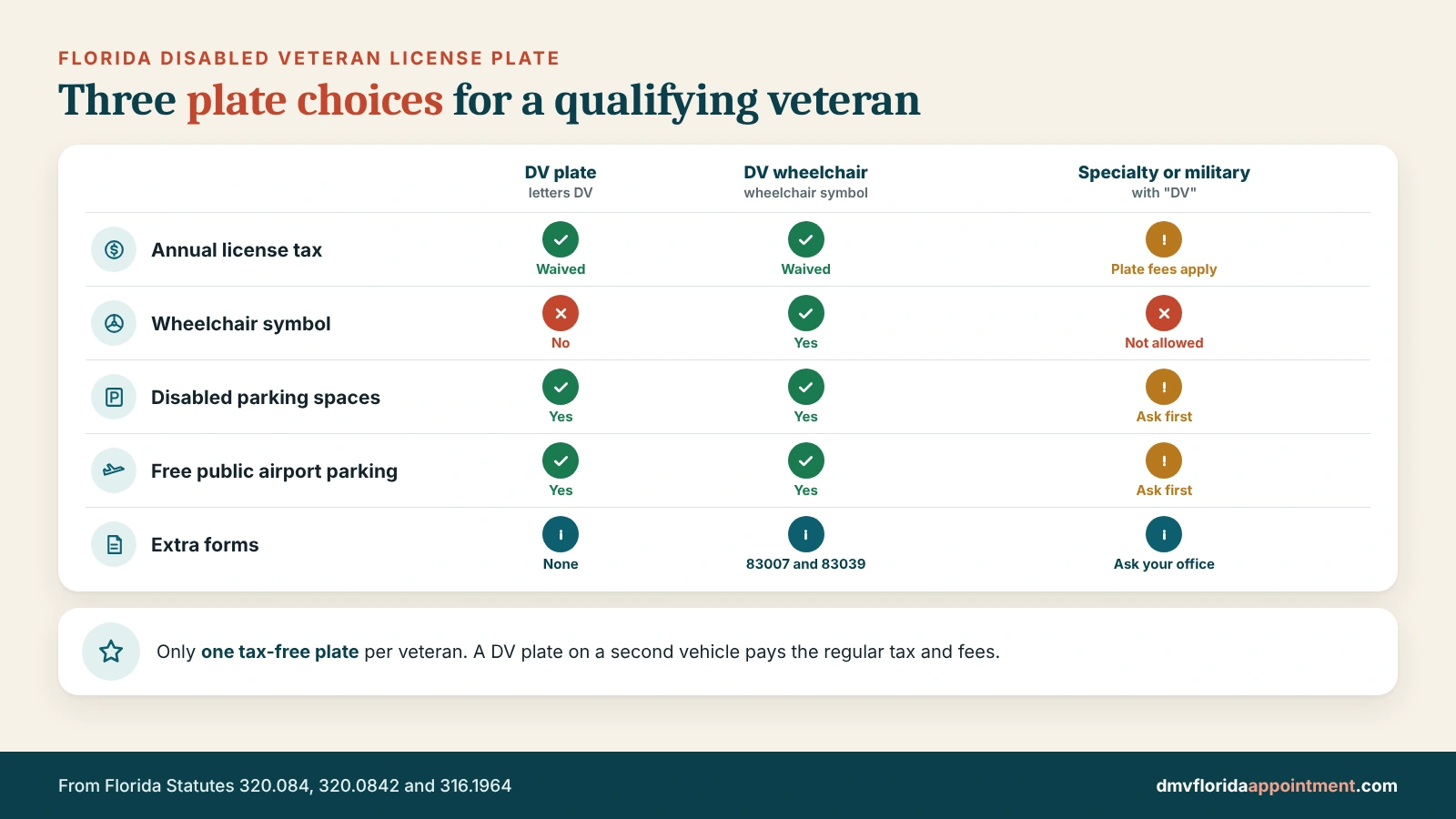
The standard DV plate suits most veterans. Choose the DV wheelchair plate if a service-connected disability means you permanently use a wheelchair, or if you also qualify for a disabled parking permit. Since a 2024 law, you can pick a military or specialty plate marked “DV” instead, but you pay its fees and it can’t carry the wheelchair symbol.
| DV plate | DV wheelchair plate | Military or specialty plate with “DV” | |
|---|---|---|---|
| Annual license tax | Waived | Waived | Waived; plate fees apply |
| Look | Red, white and blue, letters DV | Wheelchair symbol in place of DV | “DV” in the top left corner |
| Wheelchair symbol | No | Yes | Not allowed |
| Disabled parking spaces | Yes | Yes | Ask your office first |
| Extra forms | None | HSMV 83007 and 83039 | Ask your office |
From Florida Statute 320.084, 320.0842 and FLHSMV bulletin RSTL25-014. A plain “DV” designation plate for the front of the vehicle is available on request. Other military plates, such as Purple Heart, are covered in FLHSMV procedure RS-15 and our Florida license plates guide.
Does a specialty plate with “DV” give the same parking rights?
The law was changed twice, and the two versions say different things.
- Florida Statute 320.084(6), 2024 versionSaid a military or specialty plate chosen in place of the DV plate does not provide the protections of the disabled parking, parking fee and fuel-assistance laws.
- Florida Statute 320.084(6), 2026 versionSays only that such a plate can’t carry the wheelchair symbol, and doesn’t address parking rights. FLHSMV procedure RS-17 (2022) predates the option and doesn’t mention it.
If parking rights matter to you, keep the DV plate or a placard, or ask your Tax Collector or FLHSMV at 850-617-2000 before switching.
What parking rights and benefits come with a Florida DV plate?
A DV or DV wheelchair plate lets the vehicle use spaces for people with disabilities when the veteran is in it, park free at public meters and lots, and park free at publicly owned airports and timed county or city lots, which can charge regular permit holders.
Where the DV plate parks free
- Disabled parking spaces, with the veteran in the vehicle
- Public street meters and public lots
- Publicly owned airports, under Florida Statute 316.1964(7)
- Timed parking facilities run by counties and cities
FLHSMV’s permit FAQ says DV plate holders are exempt from parking fees statewide; the exception in Florida Statute 316.1964(3) is event parking at venues such as stadiums and cruise terminals, which can charge everyone.
Other benefits
- Fuel help: at a full-service station with cheaper self-service pumps, an attendant pumps your fuel at a self-service pump if you ask and you are driving (Florida Statute 526.141).
- Same number for life: you keep the plate’s number when it is renewed, reissued or moved to another vehicle you own.
- Free replacement every 10 years: the first tax-free plate is reissued with no advance replacement fee.
- Stolen plate: no plate or decal fee with a police report.
From FLHSMV procedure RS-16, which lists DV and DV wheelchair plates among the plates allowed in disabled spaces, and Florida Statute 320.0848, which gives these plates the same parking privileges as a permit.
Do you need a placard, a DV plate or both?
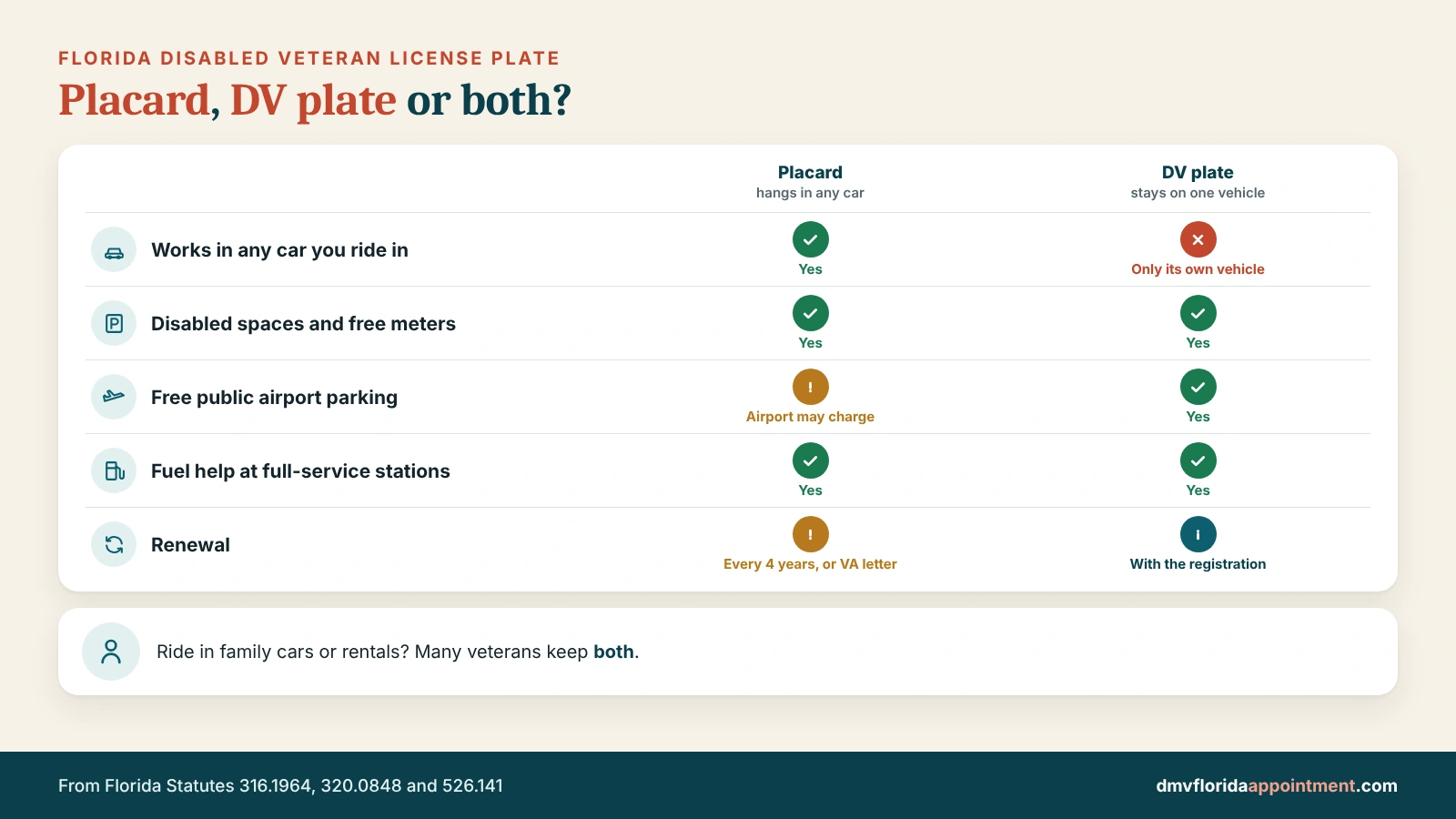
A DV plate works only on the vehicle it is on. A disabled parking placard goes with you into any car, such as a family member’s or a rental. If you ride in other vehicles, many veterans keep both, and the placard can be renewed with VA Form Letter 27-333 instead of a medical form.
| Disabled parking placard | DV plate | |
|---|---|---|
| Works in any car you ride in | Yes | No, only its own vehicle |
| Disabled spaces and free meters | Yes | Yes |
| Free parking at public airports | Airports may charge | Yes |
| Cost | Free for a long-term placard | No annual license tax |
| Renewal | Every 4 years, or VA Form Letter 27-333 | With the vehicle registration |
Apply for the placard with form HSMV 83039; our Florida disabled parking permit guide covers who signs it and how renewal works.
How do you renew, move or return a DV plate?
Renew yearly or every two years at any Tax Collector office, confirming in writing or out loud that you are still eligible. Move the plate to another vehicle you own when you sell, and return it if the rating drops below 100 percent, you leave Florida or the veteran dies.
Renewal
Each renewal needs a statement that you are still eligible. A false certification is a noncriminal violation with a $50 civil penalty, under Florida Statute 320.084(4).
Selling the vehicle
Take the plate off when you sell. You can move it to another vehicle in your name as owner, co-owner or lessee, and keep the same number.
When to return it
- The veteran dies; a co-owner needs a new plate
- The rating drops below 100 percent
- The veteran no longer owns the vehicle
- The veteran is no longer a Florida resident
From FLHSMV procedure RS-17. Lost or damaged plates are replaced with form HSMV 83146.
Florida disabled veteran license plate questions
Who qualifies for a Florida disabled veteran license plate?
A veteran with an honorable discharge who has lived in Florida for the past five years, or has filed a Florida domicile declaration, and who has a 100 percent service-connected disability rating from the VA or the Armed Forces, or a vehicle bought with VA financial help.
How much does a disabled veteran license plate cost in Florida?
The first DV plate is free of the annual license tax, so you pay only small charges such as the service fee and reflectorization at each renewal. A DV plate on a second vehicle carries the regular tax and fees.
Can I park in handicapped spaces with a DV plate in Florida?
Yes. Florida law lets vehicles with a DV or DV wheelchair plate park in spaces for people with disabilities, and treats the plate like a disabled parking permit. Use the space only when the veteran is in the vehicle.
Do disabled veterans pay for parking in Florida?
Not at public meters and public lots. Florida Statute 316.1964 also requires publicly owned airports and timed county or city lots to give free parking to vehicles with a disabled veteran plate, even though they may charge regular permit holders.
Can I get a specialty plate instead of the DV plate?
Yes. Since a 2024 law, an eligible veteran can choose a military plate or a specialty plate with “DV” in the top left corner instead. You pay that plate’s own fees, apart from those already waived, and it can’t carry the wheelchair symbol.
Can I have a DV plate on more than one vehicle?
Only one tax-free DV or DV wheelchair plate is issued to each veteran. FLHSMV procedure RS-17 lets you put a DV plate on another vehicle you own, but that one carries the regular annual tax and plate fees.
What happens to the DV plate if the veteran dies or sells the car?
Return it to a Tax Collector office. FLHSMV procedure RS-17 also requires a return if the rating drops below 100 percent or the veteran leaves Florida. When you sell the car, you can move the plate to another vehicle you own instead.