Florida Motorcycle License: Endorsement or Motorcycle-Only, Rider Course and Fees
Already drive a car, starting from scratch, or moving here with an endorsement? Find your path to a Florida motorcycle license, the rider course you need, the fees, and the one-year deadline most riders miss.
By DMV Florida Guide Team · Reviewed by Content Accuracy Team · checked against Florida Statutes and FLHSMV
A Florida motorcycle license is either an endorsement added to your Class E license or a motorcycle-only license. You need one for any two- or three-wheel motorcycle over 50 cc. New riders must pass the Basic RiderCourse, then visit an office within one year; the endorsement fee is $7.
Which Florida motorcycle license path is yours?
Answer four questions to see whether you need an endorsement or a motorcycle-only license, which course to take and what you’ll pay. Add the date you passed the course and we’ll work out your office deadline and give you a calendar reminder.
Motorcycle endorsement or motorcycle-only license?
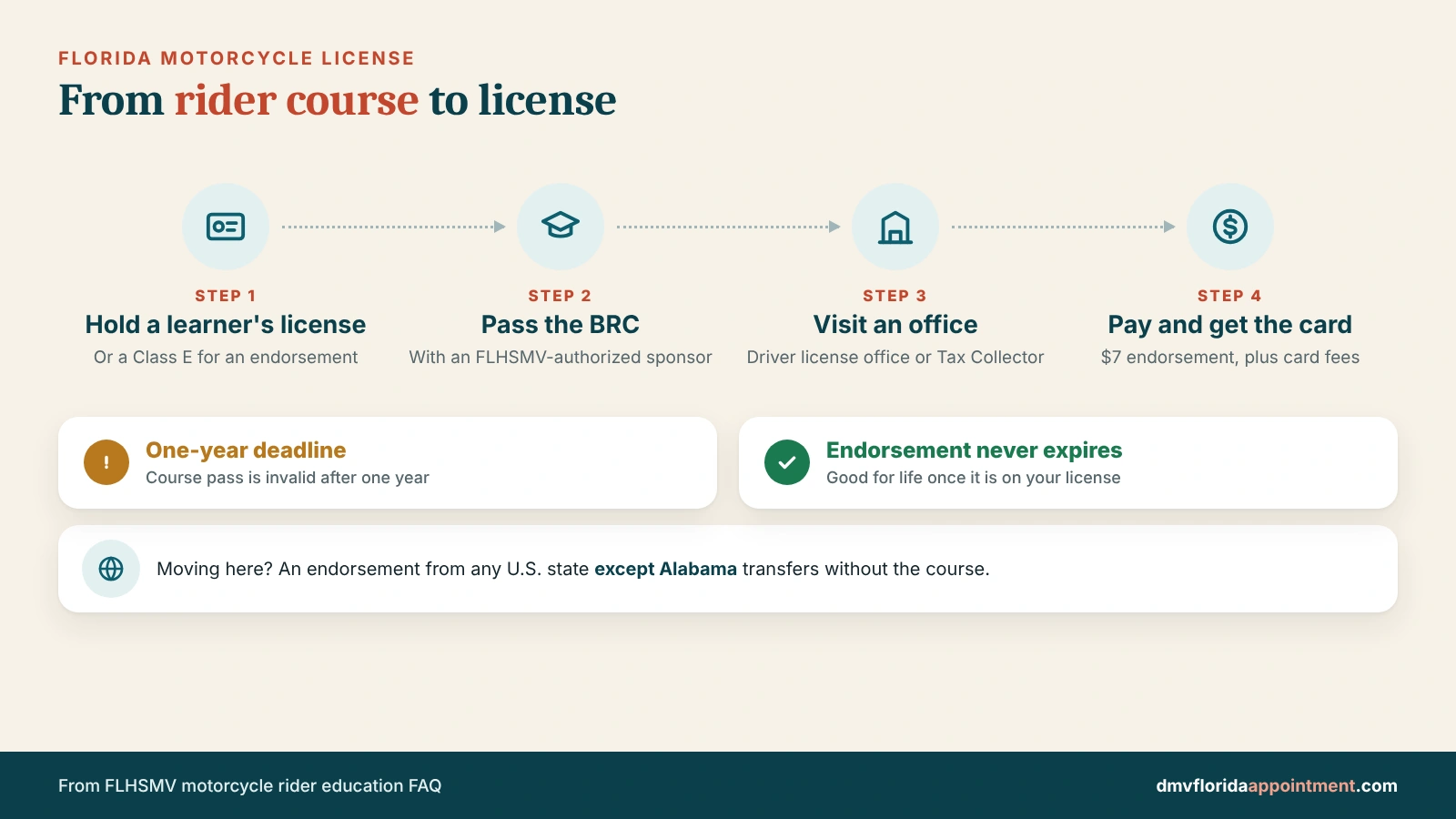
If you already hold a Florida Class E license, you add a “Motorcycle Also” endorsement to it. If you have only a learner’s license and don’t plan to drive cars, you get a motorcycle-only license. Both need the same rider course.
| Endorsement (“Motorcycle Also”) | Motorcycle-only license | |
|---|---|---|
| Who it is for | Class E or CDL holders | Riders with a learner’s license who won’t drive cars |
| What you can ride | Motorcycles plus every vehicle your license covers | Motorcycles only |
| Course | Basic RiderCourse (BRC or BRCu) | Basic RiderCourse (BRC or BRCu) |
| Extra tests | None at the office | Class E knowledge test (already passed for your learner’s license); no car road test |
| State fees | $7, plus $25 for a new card unless added at renewal | $48 license plus $7 |
| Tax Collector service fee | $6.25 | $6.25 |
Fees from FLHSMV’s fee schedule, Florida Statute 322.21 and the motorcycle FAQ. The Manatee County Tax Collector lists $32 to add the endorsement with a replacement card, before the service fee, and charges the $7 again each time you renew a license that carries the endorsement. Veterans with the veteran designation on file don’t pay the $6.25 service fee on many card transactions.
How do you get a motorcycle license in Florida?
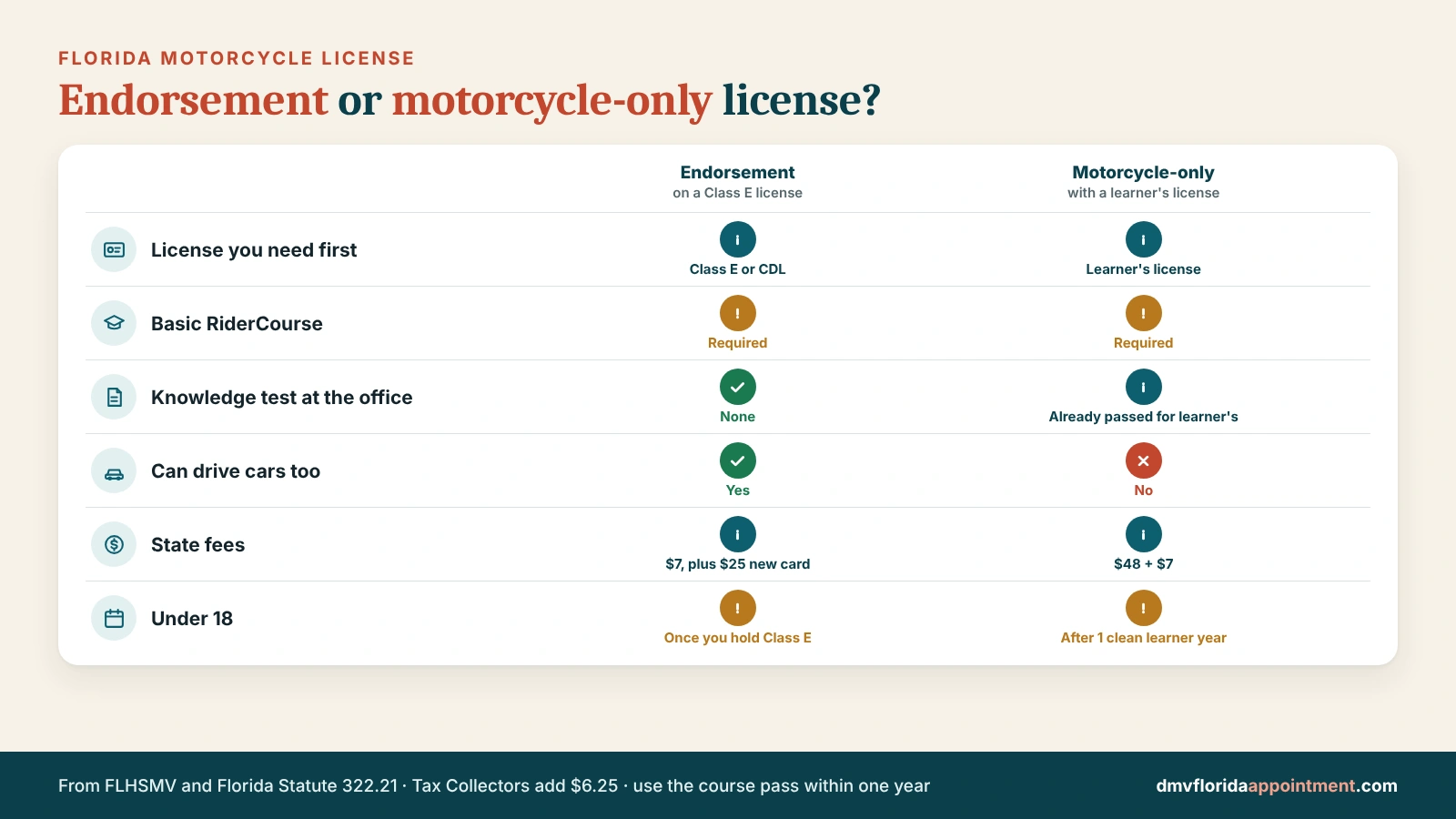
Hold at least a learner’s license, pass the Basic RiderCourse with an authorized sponsor, then visit a driver license office or Tax Collector within one year to have the endorsement or motorcycle-only license issued.
- Hold at least a learner’s licenseYou need a Florida learner’s license or higher to enroll in the rider course. Adding an endorsement needs a full Class E license.
- Pass the Basic RiderCourseTake the BRC or BRCu with an FLHSMV-authorized Florida Rider Training Program sponsor. The sponsor sends your passing result to FLHSMV.
- Visit an office within one yearGo to a driver license office or Tax Collector, say you completed the course, and show proper ID. After one year the completion is no longer valid.
- Pay and get your cardThe endorsement is $7. Tax Collectors add a $6.25 service fee, and a new card or a motorcycle-only license adds the license fee.
No permit step
You don’t need a separate motorcycle permit to start. FLHSMV only asks for at least a learner’s license to enroll in the BRC.
The course is the test
Under Florida Statute 322.12, every first-time motorcycle applicant must prove they finished a safety course, and that course includes the motorcycle knowledge and skills tests.
Don’t miss the year
If you don’t add the endorsement within one year of passing, the completion card is invalid and you must retake the course. That is the most expensive mistake on this list.
Course price: FLHSMV says you pay the course provider separately, and it doesn’t publish one price. Compare sponsors on the official Florida Rider Training Program list. For the 3-wheel course, some sponsors supply a training trike; otherwise you bring your own, with insurance and a helmet.
How old do you have to be for a Florida motorcycle license?
16 is the minimum. At 16 or 17 you must have held a learner’s license for one year with no traffic convictions before a motorcycle-only license; at 18 or older a learner’s license alone is enough.
15
Too young to ride, but old enough for a learner’s license. Our learner’s permit guide covers the course and test.
16 and 17
Enroll in the BRC with a learner’s license. A motorcycle-only license comes after one conviction-free year; an endorsement comes once you hold a Class E license.
18 and older
No waiting year. A learner’s license and a passed BRC are enough for a motorcycle-only license.
From FLHSMV’s motorcycle rider education FAQ. Riders under 21 also get a license plate of a different design on a motorcycle registered in their name, under Florida Statute 316.211(6).
Do trikes, scooters, mopeds and autocycles need a motorcycle license?
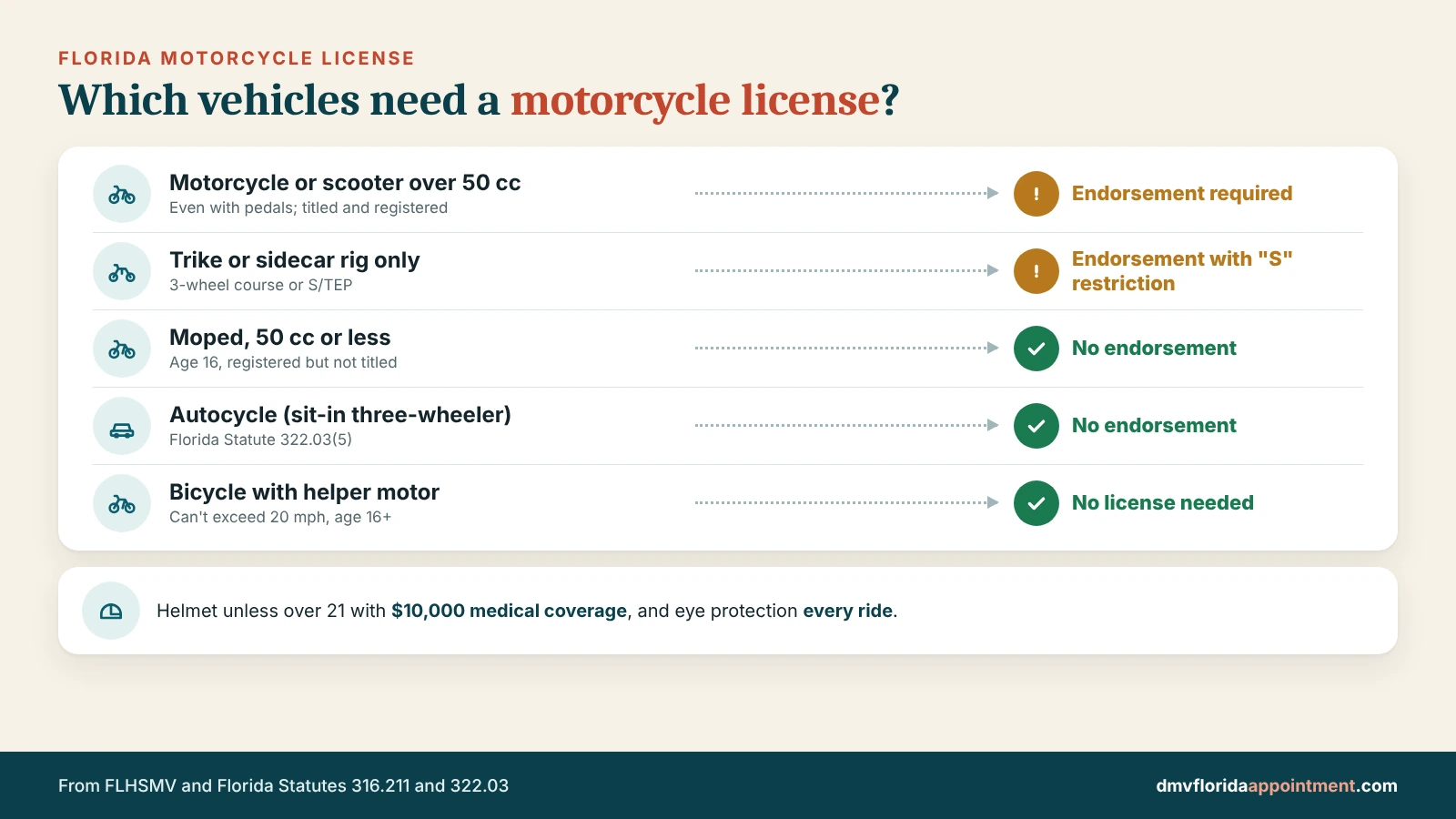
Any two- or three-wheel vehicle with an engine over 50 cc needs an endorsement or motorcycle-only license, scooters included. At 50 cc or less you need no endorsement, and an autocycle needs none either.
| Vehicle | Endorsement needed? | What applies |
|---|---|---|
| Motorcycle or scooter over 50 cc | Yes | Over 50 cc is a motorcycle, even with pedals; titled and registered |
| Trike or sidecar only | Yes, with “S” | 3-Wheel Basic RiderCourse or S/TEP limits you to more than two wheels |
| Moped, 50 cc or less | No | Age 16 and a Class E or motorcycle-only license; registered, not titled |
| Autocycle (sit-in three-wheeler) | No | A regular driver license, under Florida Statute 322.03(5) |
| Bicycle with helper motor up to 20 mph | No license | Age 16 or older |
From FLHSMV’s motorcycle, moped and scooter page, its motorcycle FAQ and Florida Statute 322.03. A regular “Motorcycle Also” endorsement already covers three-wheelers, so riders who have it don’t need the S/TEP course.
Can you transfer a motorcycle endorsement to Florida?
Yes. Florida recognizes a motorcycle endorsement from any U.S. state except Alabama, from U.S. territories, Canada, France, Germany, Taiwan and the U.S. military. You skip the course and tests when you transfer your license.
Alabama
An Alabama endorsement counts only with a Motorcycle Safety Foundation course completion card no more than a year old. Otherwise take the Florida course.
Course card from elsewhere
An MSF BRC or 3WBRC card, or an Evergreen Safety Council S/TEP card, less than a year old lets you add the endorsement without testing.
Stationed outside Florida
Take an MSF or S/TEP course run by any military branch, then bring the card to a Florida office, or license in your state of residence.
All from FLHSMV’s motorcycle FAQ. Moving your whole license? Our out-of-state license transfer guide lists the documents.
What does Florida require once you have your motorcycle license?
Wear eye protection every time, and a helmet unless you are over 21 with at least $10,000 in medical insurance for crash injuries. Insurance isn’t needed to register a motorcycle, but a crash can still make you buy it.
Helmet and eyes
Under Florida Statute 316.211, helmets must meet federal standard FMVSS 218. The over-21 insurance exception covers the helmet only, never eye protection.
Insurance
FLHSMV says insurance isn’t required to register a motorcycle. If you are charged in a crash with injuries and had no liability coverage, you must buy it and keep it for three years.
Title and plate
Motorcycles and scooters over 50 cc are titled and registered like cars. Our Florida vehicle registration guide covers the first plate.
Passengers have no minimum age in Florida law, FLHSMV notes, though other laws such as child endangerment can apply. Eye protection is advised for passengers but required only for the operator.
Florida motorcycle license questions
Do I need a motorcycle license to ride a scooter in Florida?
Only if the engine is over 50 cc. Anything over 50 cc counts as a motorcycle, even with pedals. At 50 cc or less you need no endorsement, but you must be 16 or older with a Class E or motorcycle-only license.
How old do you have to be to get a motorcycle license in Florida?
16. Under 18, you also need to have held a learner’s license for one year with no traffic convictions before you can get a motorcycle-only license.
Is there a written motorcycle test in Florida?
Not a separate one at the office. The Basic RiderCourse includes the motorcycle knowledge and skills tests, and a motorcycle-only applicant needs the Class E knowledge test, which you already passed for your learner’s license.
Does a Florida motorcycle endorsement expire?
No. Once it is on your license, FLHSMV says it is good for life. Tax Collectors such as Manatee still charge the $7 endorsement fee again each time you renew a license that carries it.
Can I use my motorcycle endorsement from another state in Florida?
Yes, from any U.S. state except Alabama, plus U.S. territories, Canada, France, Germany, Taiwan and the U.S. military. An Alabama endorsement counts only with an MSF course card no more than a year old.
Do I need a motorcycle endorsement for a three-wheeler or Slingshot?
A three-wheel motorcycle over 50 cc needs one; the 3-Wheel Basic RiderCourse gives an endorsement with an “S” restriction. An autocycle, which you sit in rather than straddle, needs no motorcycle endorsement under Florida Statute 322.03.
Do you have to wear a helmet on a motorcycle in Florida?
Yes, unless you are over 21 and carry an insurance policy with at least $10,000 in medical benefits for crash injuries. Eye protection is required for every operator, with or without a helmet.